Reading Lesson Plan: Fledgling Reader (Stage 3)
A serial of lessons that require students to read and understand a unproblematic narrative text.
Text details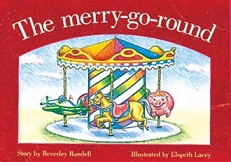
'The Merry Become Round' – PM Red, Beverley Randell, Illustrations Elspeth Lacey ©1993.
Lesson overview
This guided reading lesson volition require students to read and understand a simple narrative text.
The text provides opportunities to:
- explore literal and inferential comprehension
- place and acquire high frequency words
- recognise text that has repeated and familiar structures
- place contextual characteristics such every bit bolded text to emphasise meaning
- recollect critically about how the author and illustrator portray the characters in the text.
Text contains
The text contains:
- some repeated structures, e.yard. Look at ……/ ……is upwardly on a ………
- high frequency words, e.g. come, hither, is, a, on, look, at, said, no
- common nouns, eastward.g. hog, duck, horse, car, plane
- proper nouns, e.g. Dad, James, Kate, Nick
- bolded text (No, equus caballus).
Literal and inferential comprehension
Foundation
Reading and viewing
Use comprehension strategies to understand and discuss texts listened to, viewed or read independently. For more information, see: Content clarification VCELY153
Level i
Reading and viewing
Use comprehension strategies to build literal and inferred significant about key events, ideas and information in texts that they listen to, view and read by drawing on growing knowledge of context, text structures and language features. For more information, meet: Content description VCELY186
Links to Victorian Curriculum - English as an Boosted Linguistic communication (EAL)
Pathway A
Reading and viewing
Level A1
-
Understand aspects of simple, familiar texts (VCEALC031)
Level A2
- Understand information in texts read and viewed in course (VCEALC113)
- Use cognition of context, text structure and language to understand literal and inferred meanings (VCEALC114)
Pathway B
Reading and viewing
Level BL
- Acquire information from elementary images, with teacher management and support (VCEALC186)
- Make simple predictions or inferences near a text, with support (VCEALC189)
Level B1
- Larn some data from a small range of images (VCEALC266)
- Make simple predictions or inferences about a text (VCEALC269)
Learning intention
We are learning to utilise literal and inferential levels of comprehension to help united states of america understand what nosotros read.
Success criteria
I tin reply a literal and inferential question most the text I read.
Theory/practice connections
When readers make inferences they are able to understand the text at a deeper level. They can empathize data that the author has non stated explicitly by recognising and making links between text clues (text or illustrations) and their background information on the field of study (Davis, 2015).
Making inferences contributes to a reader'southward overall comprehension; the ultimate aim of reading. To teach students how to brand inferences, "straight explanation and modelling of the inferential process" must occur (Dewitz and Dewitz, 2003, p.432).
Role of the reader
Text Decoder/ Text Participant
Lesson sequence
- Clearly articulate the learning intention.
- When yous read, information technology is of import to understand what you are reading about. To help us empathise, today we are learning nigh literal and inferential comprehension. Yous will know if you have been successful at learning about literal and inferential comprehension if you can join in the grouping discussion at the end to answer a question virtually what you have read.
- Manus text to each pupil. Read title and discuss the forepart cover. Ensure student understanding of merry-get-rounds.
- Page 1: Instructor led discussion on characters in story-Dad, James, Kate and Nick (abbreviated form of Nicola). Students repeat character names and locate in the text.
- Teacher and students await through the pages. Teacher models the sentence structure pattern through their talk (east.g. Who is up on the pig? James is up on the pig. Who is upwardly on the duck? Kate is up on the duck. Who is up on a horse?).
- Students read text quietly to themselves. They may need to read twice for understanding. During this time, the teacher hears each kid in the group read individually. The teacher selects prompts to back up the learning needs of each kid. (e.g. Does that make sense? What discussion could go at that place that makes sense?).
- After all have read return to the text to check for comprehension. Enquire students to answer some literal questions (e.yard. Who is in the story? What was Kate upward on?). Use the term 'literal' and explicate what it means. Ask students to detect a page in the text that answers one of prompted questions and read information technology to the grouping (i.eastward.: Literal questions are answered directly in the text).
- Text, prompt students to think inferentially. Employ the term 'inferential' and demonstrate how to think inferentially. Turn dorsum to pages eight, ix, x and 11. Examine the text clues. Firstly, look at the body linguistic communication of Nick in the ii illustration pages. Why exercise you find about the expression on Nick's face ? Why does she accept her arms crossed? Link to bold writing on page 10 "No!" Ask why the writer has used bold writing. Compare Nick'southward body language on page 10 with her body language on the final page? How has it inverse?
- Activate the background knowledge of students. What practise they know virtually fiddling brothers or sisters and how they make choices? Students to discuss. Instructor relates their examples to Nick.
- Making an inference requires linking text clues and groundwork noesis. Ask students to link the ideas just discussed and lead them to making an inference based on the question, "Why does Nick choose to ride upwards on the horse rather than the car or plane?".
- Return to the learning intention and success criteria. Ask students who could answer a literal question? An inferential question? Record anecdotal responses for future planning.
High frequency words
Links to the curriculum
Foundation
Writing
Understand that spoken sounds and words can be written and know how to write some high-frequency words and other familiar words including their name. For more data, encounter: Content description VCELA157
Level one
Writing
Understand how to utilise visual retention to write high-frequency words, and that some high-frequency words have regular and irregular spelling components. For more than information, come across: Content description VCELA184
Links to Victorian Curriculum - English as an Additional Language (EAL)
Pathway A
Reading and viewing
Level A1
- Recognise familiar words and phrases (VCEALL046)
- Recognise some familiar words in context (VCEALL048)
Level A2
- Focus on both content and functional words to understand the main idea in a text (VCEALL126)
- Recognise a small range of familiar words in unlike contexts (VCEALL129)
Writing
Level A1
- Spell with accurateness some consonant–vowel–consonant words and common words learnt in the classroom (VCEALL080)
Level A2
- Spell with accurateness familiar words and words with mutual letter patterns (VCEALL159)
Pathway B
Reading and viewing
Level BL
- Recognise some common words or phrases (VCEALL206)
Level B1
- Read some familiar words and phrases (VCEALL286)
Writing
Level BL
- Spell a number of high-frequency words accurately (VCEALL237)
Level B1
- Spell accurately common words encountered in the classroom (VCEALL318)
Learning intention
Nosotros are learning to recognise and read some high frequency words in this text.
Success criteria
I can read a high frequency give-and-take and detect it in the text.
Theory/practice connections
Sight words or loftier frequency words demand to exist learnt to the point of automaticity because phonic attempts volition not aid readers decode words such every bit 'here', 'come' and 'said'. Automaticity ensures words are stored in a reader's visual memory and immediately recognised when encountered in text. Konza argues that the most efficient fashion of learning sight words it to teach them explicitly and so immediately consolidate the learning through reading meaningful text (2010, pp. 3-4).
When high frequency words are known, it frees the reader up to concentrate on the content words which contribute to meaning.
Role of the reader
Text decoder.
Lesson sequence
- Clearly articulate the learning intention.
- Today we are learning some loftier frequency words to help us with our reading. Loftier frequency words appear in texts a lot, so that is why we are learning them. We volition look at the letters in each word to assistance us remember them. Subsequently we have read, I am going to inquire you to discover some of them in your book. You volition know if you have been successful with your learning today if you tin read a high frequency give-and-take on a card and match it to i in your volume.
- High frequency story words written on individual cards (come, hither, is, a on, look, at, said, no). Focus on initial letter of the alphabet equally a prompt. Read together and play a word game such equally tic tac toe to place them.
- Manus text to each student. Read title and hash out the front cover. Ensure student agreement of merry-get-rounds.
- Folio one: Teacher introduces characters in story: Dad, James, Kate and Nick (abbreviated form of Nicola). Students repeat character names and locate in the text. Use initial letter of the alphabet to prompt.
- Instructor and students look through the pages. Teacher models the sentence structure pattern through their talk (e.thousand. Who is up on the pig? James is up on the pig. Who is upwards on the duck? Kate is upward on the duck. Who is up on a horse?).
- Students read text quietly to themselves. They may need to read twice for understanding. During this time, the teacher hears each child in the grouping individually. The teacher selects prompts to support the learning needs of each child (e.m. Look at the kickoff letter. What sound does information technology brand? Does that word look right?).
- Later on all have read render to the text to bank check for comprehension. Enquire students to retell the text in sequence (i.e. requite literal information).
- Return to the high frequency cards introduced at the offset of the lesson. Students select a card with a high frequency word written on it. They must locate that discussion in the text. How many times can they find it? Share findings with group members.
- Return to the learning intention and success criteria. Ask students who could read and notice a loftier frequency word in the text. Tape anecdotal responses for future planning.
Going further
Provide minor whiteboards for students. Students exercise writing the high frequency words located in the text several times (e.chiliad. write the word 'come' very pocket-size, very large, tall, skinny, in bubble writing, capitals, with curly letters). Write words in personal dictionary.
ABC Pedagogy Literacy Mini Lessons
The Department collaborated with ABC Education to create a series of videos. All xvi mini lessons based on content from the Literacy Teaching Toolkit are bachelor on the ABC Education literacy mini lessons page.
Messages, words and sentences
Links to the Victorian Curriculum - English
Foundation
Reading and viewing
Recognise that texts are made up of words and groups of words that brand significant. For more information, come across: Content clarification VCELA144
Recognise all upper- and lower-example letters and the nigh common audio that each letter represents. For more information, see: Content description VCELA146
Links to Victorian Curriculum - English as an Additional Language (EAL)
Pathway A
Reading and viewing
Level A1
- Understand that texts are meaningful (VCEALA035)
- Identify some sounds in words (VCEALL050)
- Recognise capital letter messages, spaces and full stops (VCEALL052)
Level A2
- Recognise all messages of the alphabet (VCEALL130)
- Chronicle near letters of the alphabet to sounds (VCEALL131)
Pathway B
Reading and viewing
Level BL
- Recognise the messages of the alphabet (VCEALL208)
- Understand the function of spaces, capital letter letters and full stops (VCEALL209)
- Distinguish Roman script from non-Roman script (VCEALA039)
Level B1
- Recognise the difference between texts in English and texts in other languages (VCEALA275)
Learning intention
We are learning that text is fabricated up of letters, words and sentences.
Success criteria
I tin discover a letter, give-and-take and sentence in my text and say how each one is different.
Theory/practice connections
Concepts of print are developed as students begin to learn to read. Readers demand to know that impress carries a bulletin and is fabricated upwardly of messages, words and sentences. A letter is on its own, a give-and-take contains a grouping of messages with a infinite effectually it and a judgement is a grouping of words that is a "consummate thought" (Hill, 2015, p. 208).
It is important to use the metalanguage (letter, word, sentence) and ensure students are clear about what each term means. It is proven to be an "indicator of i grouping of behaviours which back up reading acquisition" (Dirt, 1993, p. 47).
Role of the reader
Text decoder/Text user
Lesson sequence
- Clearly articulate the learning intention. Today we are learning that a text is fabricated up of letters, words and sentences. We are going to learn what each one is. Past the end of the lesson you lot will be able to find a letter, word and judgement. You will too be able to tell me how each ane is different.
- Hand text to each educatee. Read title and hash out the forepart cover. Ensure pupil understanding of merry-go-rounds.
- Folio i: Teacher lead give-and-take on characters in story-Dad, James, Kate and Nick (abbreviated course of Nicola). Students repeat grapheme names and locate in the text.
- Teacher and students look through the pages. Teacher models the judgement structure pattern through their talk (e.g. Who is up on the pig? James is upward on the pig. Who is up on the duck? Kate is upwardly on the duck. Who is up on a horse?).
- Students read text quietly to themselves. They may need to read twice for understanding. During this time, the teacher hears each child in the group read individually. The teacher selects prompts to support the learning needs of each child (e.k. Look at the first letter? What sound does that make? Point to the word that starts with 's.').
- After all accept read return to the text to check for comprehension. Ask students to retell the text in sequence (i.e. give literal information).
- Turn to folio vi. Ask students to find the word 'Kate'. Count the number of messages in her proper name. Find another discussion with 4 letters on that folio (look, duck). Repeat this procedure with the 2 alphabetic character words (at, is, up, on). Hash out the difference betwixt a word and a letter.
- Inquire students to plow to the last page. Read sentence together. On a pre-prepared card, accept the sentence written: Nick is upwards on a horse. Locate the capital letter of the alphabet and full finish, which bespeak the get-go and end of the sentence.
- As students read the judgement strip makes cuts at the discussion level. Count the number of words in the sentence. Students reassemble using the final judgement in the text as a guide.
- Play a word hunt game. Find the letter 'south' on page 4. Find the word 'look' on page 4. Detect the sentence 'Here is a equus caballus' on page 12.
- Return to the learning intention and success criteria. Ask students to define a letter, word and sentence and who can find an example of each. Tape anecdotal responses for time to come planning.
Thinking critically about text
Links to the Victorian Curriculum
Foundation
Reading and viewing
Utilize comprehension strategies to understand and discuss texts listened to, viewed or read independently. For more information, encounter: Content description VCELY153
Recognise that texts are created past authors who tell stories and share experiences that may be similar or dissimilar to students' own experiences. For more information, run into: Content description VCELT148
Level one
Reading and viewing
Use comprehension strategies to build literal and inferred meaning well-nigh cardinal events, ideas and information in texts that they listen to, view and read by drawing on growing knowledge of context, text structures and language features. For more information, see: Content description VCELY186
Reply to texts drawn from a range of cultures and experiences. For more data, come across: Content description VCELY185
Links to Victorian Curriculum - English as an Additional Linguistic communication (EAL)
Pathway A
Reading and viewing
Level A1
- Understand aspects of elementary, familiar texts (VCEALC031)
Level A2
- Understand data in texts read and viewed in form (VCEALC113)
- Utilise knowledge of context, text structure and linguistic communication to sympathize literal and inferred meanings (VCEALC114)
- Empathize that texts tin reflect a variety of ideas and perspectives (VCEALA118)
Pathway B
Reading and viewing
Level BL
- Respond to and appoint with an increasing range of texts nearly familiar and new content (VCEALA193)
Level B1
- Respond to familiar and new content in texts (VCEALA273)
Learning intention
We are learning to recall critically by talking about how the writer and illustrator makes us think about the characters in the text.
Success criteria
I can join in the word about Nick and her family and requite my reasons for the way the illustrator drew Nick.
Theory/practice connections
Learning to call up critically contributes to deeper comprehension equally it requires the reader to evaluate the author (or illustrator'due south) viewpoint and how that may exist positioned within the text (often implicitly).
Once a reader tin can recognise that no text is neutral and all texts are crafted objects, the information independent within a text can exist understood on more than than one level (Freebody and Luke, 1990).
Learning to think critically forms role of a wider set of successful reading practices which must brainstorm alongside learning to decode. Freebody and Luke (1990) argue for the importance of teaching critical thinking "at kindergarten or in adult ESL classes, or any point in between. Information technology must be taught "systematically, explicitly, and at all developmental points"( p. 15).
Scull (2010) argues that it is a teacher's part to encourage students to share and defend their ideas and those that are independent in texts. By doing so, teachers provide the opportunity for students to develop "positive reading outcomes" (p. 97).
Part of the reader
Text annotator.
Lesson sequence
- Conspicuously clear the learning intention. Today we are going to talk about how the author and the illustrator make us recollect about the characters in this book. This is called thinking critically. Afterward we have read the book, we are going to talk near Nick and what we think near her. You volition know if you have been successful at thinking critically, if you tin join in the word and give a reason why you think that manner.
- Mitt text to each student. Read title and talk over the forepart cover. Ensure student understanding of merry-get-rounds.
- Page i: Teacher led word on characters in story-Dad, James, Kate and Nick. Students echo graphic symbol names and locate in the text. Match the name to the illustration of the character.
- Teacher and students look through the pages. Teacher models the text structure through their talk (e.thou. Who is up on the pig? James is up on the pig. Who is up on the duck? Kate is up on the duck. Who is up on a horse?).
- Students read text quietly to themselves. They may demand to read twice for understanding. During this time, the teacher hears each child in the group read individually. The teacher selects prompts to support the learning needs of each child.
- After all have read return to the text to check for comprehension. Ask students to retell the text in sequence (i.e. requite literal information).
- Remind students of the learning intention and success criteria. Ask students to plow back to pages 8 to 11. Inquire students to retrieve what things Dad suggested Nick should ride in (car, plane). Students read out Dad's suggestions. Plough to concluding page and students read the text which confirms Nick's pick of a horse.
- Tell students that Nick is a girl and her name is actually Nicola.
- Ask students: Why has the illustrator drawn Nick similar that? Did you call up the character was a girl or boy? What made y'all think that? Would Nick'south choice take been different if she was a boy?
- Return to the learning intention and success criteria. Ask students if they were able to join in the discussion and give reasons for why they thought the author and illustrator positioned Nick the manner they did. What did they think? Why? Record anecdotal responses for time to come planning.
medinafarretionly.blogspot.com
Source: https://www.education.vic.gov.au/school/teachers/teachingresources/discipline/english/literacy/readingviewing/Pages/exampleguidedlevel3.aspx
0 Response to "Reading Lesson Plan: Fledgling Reader (Stage 3)"
Post a Comment