Animation Art From Pencil to Pixel the History of Cartoon Animeãœâ Cgi

Painting with acrylic pigment on the reverse side of an already inked cel, here placed on the original blitheness drawing
Traditional blitheness (or classical animation, cel animation, hand-fatigued animation, or 2D animation) is an blitheness technique in which each frame is drawn by mitt. The technique was the dominant course of animation in movie house until estimator blitheness.
Procedure [edit]
Writing and storyboarding [edit]
Animation product usually begins after a story is converted into an animation pic script, from which a storyboard is derived. A storyboard has an appearance somewhat similar to comic book panels, and is a shot by shot breakdown of the staging, acting and any camera moves that will be present in the film. The images permit the animation squad to plan the menstruum of the plot and the composition of the imagery. Storyboard artists volition accept regular meetings with the managing director and may redraw or "re-board" a sequence many times before it meets terminal approval.
Voice recording [edit]
Before animation begins, a preliminary soundtrack or scratch track is recorded so that the animation may be more precisely synchronized to the soundtrack. Given the slow manner in which traditional blitheness is produced, it is almost e'er easier to synchronize animation to a pre-existing soundtrack than information technology is to synchronize a soundtrack to pre-existing animation. A completed cartoon soundtrack volition feature music, sound effects, and dialogue performed past phonation actors. The scratch runway used during animation typically contains just the voices, any songs to which characters must sing-along, and temporary musical score tracks; the terminal score and sound effects are added during post-production.
In the case of Japanese animation and nigh pre-1930 sound animated cartoons, the sound was mail-synched; the soundtrack was recorded after the film elements were finished by watching the moving picture and performing the dialogue, music, and audio effects required. Some studios, most notably Fleischer Studios, connected to mail-synch their cartoons through most of the 1930s, which immune for the presence of the "muttered ad-libs" present in many Popeye the Crewman and Betty Boop cartoons.[one]
Blueprint, timing, and layout [edit]
When storyboards are sent to the pattern departments, grapheme designers fix model sheets for any characters and props that announced in the film; and these are used to help standardize appearance, poses, and gestures. The model sheets will often include "turnarounds" which testify how a character or object looks in three-dimensions along with standardized special poses and expressions so that the artists have a guide to refer to. Small statues known every bit maquettes may be produced so that an animator tin see what a character looks like in three dimensions. Background stylists will do similar work for whatever settings and locations nowadays in the storyboard, and the art directors and color stylists will determine the art style and colour schemes to exist used.
A timing director (who in many cases will be the main manager) will take the animatic and analyze exactly what poses drawings, and lip movements will exist needed on what frames. An exposure sheet (or 10-canvas) is created; this is a printed table that breaks downwards the action, dialogue, and audio frame-by-frame equally a guide for the animators. If a movie is based more strongly in music, a bar canvass may be prepared in improver to or instead of an X-sheet.[2] Bar sheets testify the relationship betwixt the on-screen activeness, the dialogue, and the actual musical annotation used in the score.
Layout begins afterward the designs are completed and canonical by the manager. It is here that the background layout artists determine the camera angles, camera paths, lighting, and shading of the scene. Graphic symbol layout artists will determine the major poses for the characters in the scene and will make a cartoon to signal each pose. For short films, graphic symbol layouts are frequently the responsibility of the director. The layout drawings and storyboards are then spliced, along with the sound and an animatic is formed (not to be confused with its predecessor, the leica reel).
While the blitheness is beingness done, the background artists will pigment the sets over which the activity of each animated sequence will have place. These backgrounds are more often than not washed in gouache or acrylic pigment, although some animated productions have used backgrounds washed in watercolor or oil paint. Background artists follow very closely the work of the background layout artists and color stylists (which is unremarkably compiled into a workbook for their use) and so that the resulting backgrounds are harmonious in tone with the character designs.
Animatic [edit]
Commonly, an animatic or story reel is created afterward the soundtrack is recorded and before full animation begins. The term "animatic" was originally coined by Walt Disney Animation Studios. An animatic typically consists of pictures of the storyboard timed and cut together with the soundtrack. This allows the animators and directors to work out whatsoever script and timing bug that may be with the current storyboard. The storyboard and soundtrack are amended if necessary, and a new animatic may be created and reviewed with the director until the storyboard meets the users' requirements. Editing the film at the animatic stage prevents the blitheness of scenes that would be edited out of the pic. Creating scenes that will eventually exist edited out of the completed cartoon is avoided.
Animation [edit]

Sketch of an animation peg bar, and measurements of iii types, Peak being the most common.
In the traditional animation process, animators will begin by drawing sequences of animation on sheets of transparent paper perforated to fit the peg bars in their desks, often using colored pencils, one film or "frame" at a fourth dimension.[3] A peg bar is an animation tool used in traditional animation to keep the drawings in identify. A key animator or lead animator will depict the key drawings or key frames in a scene, using the graphic symbol layouts as a guide. The key animator draws enough of the frames to get across the major poses within a grapheme performance.
While working on a scene, a key animator will usually prepare a pencil test of the scene. A pencil test is a much rougher version of the final animated scene (often devoid of many character details and color); the pencil drawings are quickly photographed or scanned and synced with the necessary soundtracks. This allows the animation to be reviewed and improved upon earlier passing the work on to their assistant animators, who will add details and some of the missing frames in the scene. The piece of work of the assistant animators is reviewed, pencil-tested, and corrected until the pb animator is ready to meet with the director and have their scene sweatboxed.
Once the cardinal blitheness is approved, the lead animator frontwards the scene on to the clean-up department, made upward of the clean-upward animators and the inbetweeners. The make clean-up animators accept the pb and assistant animators' drawings and trace them onto a new sheet of paper, making sure to include all of the details present on the original model sheets, and so that the moving picture maintains a cohesiveness and consistency in fine art manner. The inbetweeners will draw in whatever frames are still missing in-between the other animators' drawings. This process is chosen tweening. The resulting drawings are again pencil-tested and sweatboxed until they meet approval.
At each stage during pencil animation, canonical artwork is spliced into the Leica reel.[four]
This procedure is the same for both character blitheness and special effects animation, which on most high-budget productions are done in separate departments. Often, each major grapheme will accept an animator or grouping of animators solely dedicated to drawing that character. The grouping volition be made up of ane supervising animator, a minor grouping of central animators, and a larger group of assistant animators. Effects animators breathing anything that moves and are not a character, including props, vehicles, machinery and phenomena such as burn, rain, and explosions. Sometimes, instead of drawings, a number of special processes are used to produce special effects in animated films; pelting, for example, has been created in Disney blithe films since the late 1930s by filming slow-move footage of water in front of a black background, with the resulting picture show superimposed over the blitheness.
Traditional ink-and-paint and camera [edit]
Once the clean-ups and in-between drawings for a sequence are completed, they are prepared for a process known as ink-and-paint. Each drawing is and so transferred from paper to a thin, clear sheet of plastic called a cel, a contraction of the textile name celluloid (the original flammable cellulose nitrate was later replaced with the more stable cellulose acetate). The outline of the drawing is inked or photocopied onto the cel, and gouache, acrylic or a similar type of paint is used on the contrary sides of the cels to add colors in the appropriate shades. The transparent quality of the cel allows for each character or object in a frame to be animated on different cels, as the cel of 1 character can exist seen underneath the cel of another; and the opaque background volition exist seen below all of the cels.
When an entire sequence has been transferred to cels, the photography procedure begins. Each cel involved in a frame of a sequence is laid on pinnacle of each other, with the groundwork at the lesser of the stack. A slice of glass is lowered onto the artwork in society to flatten whatever irregularities, and the composite prototype is then photographed by a special animation camera, also called rostrum photographic camera.[5] The cels are removed, and the process repeats for the next frame until each frame in the sequence has been photographed. Each cel has registration holes, modest holes forth the meridian or bottom edge of the cel, which let the cel to be placed on corresponding peg bars[6] before the photographic camera to ensure that each cel aligns with the i earlier it; if the cels are non aligned in such a manner, the animation, when played at full speed, will appear "jittery." Sometimes, frames may need to be photographed more than than once, in order to implement superimpositions and other camera effects. Pans are created by either moving the cels or backgrounds 1 step at a time over a succession of frames (the camera does not pan; information technology only zooms in and out).
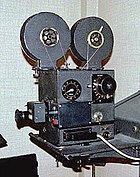
A photographic camera used for shooting traditional animation. See likewise Aeriform image.
Dope sheets are created by the animators and used by the camera operator to transfer each blitheness drawing into the number of film frames specified by the animators, whether it is 1 (1s, ones) 2 (2s, twos) or three (3s, threes).
As the scenes come out of final photography, they are spliced into the Leica reel, taking the place of the pencil animation. Once every sequence in the product has been photographed, the terminal flick is sent for evolution and processing, while the last music and audio effects are added to the soundtrack.
Mod process [edit]
Digital ink and pigment [edit]
The current process, termed "digital ink and pigment", is the same as traditional ink and paint until after the blitheness drawings are completed;[7] instead of being transferred to cels, the animators' drawings are either scanned into a estimator or fatigued directly onto a computer monitor via graphics tablets, where they are colored and candy using 1 or more of a variety of software packages. The resulting drawings are composited in the computer over their respective backgrounds, which take too been scanned into the computer (if not digitally painted), and the computer outputs the final film past either exporting a digital video file, using a video cassette recorder or printing to film using a high-resolution output device. Utilize of computers allows for easier substitution of artwork between departments, studios, and even countries and continents (in most low-upkeep American animated productions, the bulk of the blitheness is actually done by animators working in other countries, including South korea, Taiwan, Japan, China, Singapore, Mexico, India, and the Philippines). Every bit the toll of both inking and painting new cels for animated films and TV programs and the repeated usage of older cels for newer animated TV programs and films went up and the cost of doing the same thing digitally went down, eventually, the digital ink-and-pigment process became the standard for futurity animated movies and Idiot box programs.
Implementation [edit]
Hanna-Barbera was the first American animation studio to implement a computer animation system for digital ink-and-pigment usage.[8] Following a commitment to the technology in 1979, computer scientist Marc Levoy led the Hanna-Barbera Animation Laboratory from 1980 to 1983, developing an ink-and-paint organization that was used in roughly a third of Hanna-Barbera'southward domestic production, starting in 1984 and standing until replaced with third-party software in 1996.[8] [9] In addition to a cost savings compared to traditional cel painting of five to ane, the Hanna-Barbera system likewise allowed for multiplane camera effects axiomatic in H-B productions such equally A Pup Named Scooby-Doo (1988).[ten]
Digital ink and paint has been in utilize at Walt Disney Animation Studios since 1989, where information technology was used for the final rainbow shot in The Little Mermaid. All subsequent Disney animated features were digitally inked-and-painted (starting with The Rescuers Down Nether, which was also the offset major feature film to entirely use digital ink and paint), using Disney'southward proprietary CAPS (Reckoner Blitheness Production System) engineering science, developed primarily by Pixar Animation Studios. The CAPS system immune the Disney artists to make employ of colored ink-line techniques by and large lost during the xerography era, as well as multiplane effects, blended shading, and easier integration with 3D CGI backgrounds (as in the ballroom sequence in the 1991 motion-picture show Dazzler and the Beast), props, and characters.[xi] [12]
While Hanna-Barbera and Disney began implementing digital inking and painting, it took the rest of the industry longer to accommodate. Many filmmakers and studios did not want to shift to the digital ink-and-paint procedure because they felt that the digitally colored animation would look too synthetic and would lose the artful entreatment of the non-computerized cel for their projects. Many animated television series were nonetheless animated in other countries by using the traditionally inked-and-painted cel process every bit tardily every bit 2004, though most of them switched over to the digital process at some point during their run. The concluding major feature film to use traditional ink and paint was Satoshi Kon's Millennium Actress (2001); the terminal major animation productions in the w to employ the traditional process was Fob's The Simpsons and Cartoon Network's Ed, Edd n Eddy, which switched to digital paint in 2002 and 2004 respectively,[thirteen] while the terminal major blithe production overall to abandon cel blitheness was the telly adaptation of Sazae-san, which remained stalwart with the technique until September 29, 2013, when information technology switched to fully digital animation on October six, 2013. Prior to this, the series adopted digital animation solely for its opening credits in 2009, but retained the utilize of traditional cels for the main content of each episode.[14] Pocket-sized productions, such as Hair High (2004) past Bill Plympton, take used traditional cels long later on the introduction of digital techniques. About studios today utilise one of a number of other high-end software packages, such as Toon Boom Harmony, Toonz (OpenToonz), Animo, and RETAS, or even consumer-level applications such as Adobe Flash, Toon Blast Technologies and Idiot box Paint.
Techniques [edit]
Cels [edit]

This epitome shows how two transparent cels, each with a different character drawn on them, and an opaque background are photographed together to form the composite image.
The cel blitheness process was invented by Earl Hurd and John Bray in 1915. The cel is an important innovation to traditional animation, as it allows some parts of each frame to be repeated from frame to frame, thus saving labor. A simple example would be a scene with two characters on screen, ane of which is talking and the other continuing silently. Since the latter grapheme is non moving, it can be displayed in this scene using only 1 drawing, on one cel, while multiple drawings on multiple cels are used to animate the speaking character.
For a more complex example, consider a sequence in which a person sets a plate upon a table. The table stays still for the unabridged sequence, so information technology can be fatigued as part of the groundwork. The plate can be fatigued forth with the character as the grapheme places it on the tabular array. Notwithstanding, after the plate is on the table, the plate no longer moves, although the person continues to move every bit they draw their arm away from the plate. In this example, after the person puts the plate downwardly, the plate tin and then exist drawn on a divide cel from them. Further frames feature new cels of the person, but the plate does non accept to be redrawn as information technology is not moving; the same cel of the plate can be used in each remaining frame that it is even so upon the table. The cel paints were actually manufactured in shaded versions of each color to recoup for the actress layer of cel added between the image and the camera; in this example, the however plate would exist painted slightly brighter to compensate for being moved ane layer down.
In TV and other low-upkeep productions, cels were frequently "cycled" (i.e., a sequence of cels was repeated several times), and even archived and reused in other episodes. After the motion-picture show was completed, the cels were either thrown out or, especially in the early days of animation, washed make clean and reused for the next film. In some cases, some of the cels were put into the "archive" to exist used again and again for futurity purposes in gild to salve coin. Some studios saved a portion of the cels and either sold them in studio stores or presented them as gifts to visitors.
Cel overlay [edit]
A cel overlay is a cel with inanimate objects used to give the impression of a foreground when laid on pinnacle of a ready frame.[15] This creates the illusion of depth, but not every bit much as a multiplane photographic camera would. A special version of cel overlay is called line overlay, made to complete the background instead of making the foreground, and was invented to deal with the sketchy appearance of xeroxed drawings. The background was first painted as shapes and figures in flat colors, containing rather few details. Next, a cel with detailed black lines was laid directly over it, each line is drawn to add more data to the underlying shape or figure and requite the background the complication it needed. In this way, the visual mode of the background volition match that of the xeroxed character cels. As the xerographic process evolved, line overlay was left behind.
Pre-cel blitheness [edit]
How Animated Cartoons Are Made (1919), showing characters made from cutting-out paper
In very early cartoons fabricated earlier the use of the cel, such as Gertie the Dinosaur (1914), the entire frame, including the background and all characters and items, were fatigued on a single canvass of paper, then photographed. Everything had to exist redrawn for each frame containing movements. This led to a "jittery" appearance; imagine seeing a sequence of drawings of a mountain, each ane slightly different from the 1 preceding information technology. The pre-cel animation was later improved by using techniques like the slash and tear organization invented past Raoul Barre; the background and the animated objects were drawn on separate papers.[16] A frame was fabricated by removing all the bare parts of the papers where the objects were drawn before being placed on top of the backgrounds and finally photographed.
Express blitheness [edit]
In lower-budget productions, shortcuts available through the cel technique are used extensively. For case, in a scene in which a person is sitting in a chair and talking, the chair and the body of the person may be the same in every frame; merely their head is redrawn, or mayhap even their head stays the same while only their oral cavity moves. This is known equally limited animation. [17] The process was popularized in theatrical cartoons by United Productions of America and used in well-nigh television animation, especially that of Hanna-Barbera. The end result does not look very lifelike, merely is inexpensive to produce, and therefore allows cartoons to be fabricated on small television budgets.
"Shooting on twos" [edit]
Moving characters are often shot "on twos". One drawing is shown for every two frames of film (which usually runs at 24 frames per second), pregnant there are only 12 drawings per second.[xviii] Even though the image update charge per unit is low, the fluidity is satisfactory for most subjects. Nevertheless, when a character is required to perform a quick move, it is usually necessary to revert to animating "on ones", as "twos" are also slow to convey the move adequately. A blend of the two techniques keeps the eye fooled without unnecessary product costs.
University Award-nominated animator Bill Plympton is noted for his style of blitheness that uses very few in-betweens and sequences that are washed "on threes" or "on fours", holding each drawing on the screen from ane/8 to 1/half-dozen of a second.[19] While Plympton uses near-abiding three-frame holds, sometimes animation that only averages eight drawings per second is likewise termed "on threes" and is usually washed to meet budget constraints, along with other cost-cutting measures like property the same drawing of a character for a prolonged time or panning over a still image,[20] techniques often used in depression-budget Tv productions.[21] It is also common in anime, where fluidity is sacrificed in lieu of a shift towards complexity in the designs and shading (in contrast with the more functional and optimized designs in the Western tradition); fifty-fifty high-budget theatrical features such equally Studio Ghibli's employ the total range: from smooth animation "on ones" in selected shots (commonly quick action accents) to common animation "on threes" for regular dialogue and slow-paced shots.
Animation loops [edit]
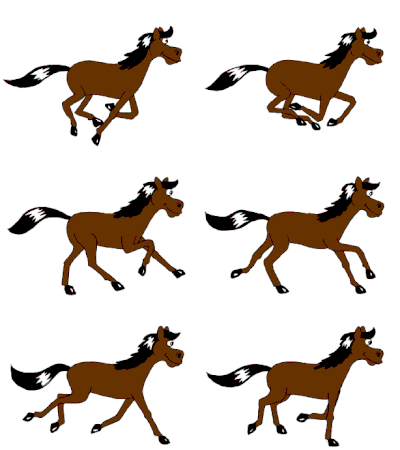
A horse blithe by rotoscoping from Eadweard Muybridge's 19th-century photos. The blitheness consists of eight drawings which are "looped", i.e. repeated over and over. This instance is besides "shot on twos", i.e. shown at 12 drawings per 2d.
Creating animation loops or animation cycles is a labor-saving technique for animating repetitive motions, such every bit a graphic symbol walking or a breeze blowing through the copse. In the example of walking, the grapheme is animated taking a step with its right foot, then a stride with its left pes. The loop is created so that, when the sequence repeats, the movement is seamless. In general, they are used only sparingly by productions with moderate or high budgets.
Ryan Larkin's 1969 Academy Honour-nominated National Pic Board of Canada short Walking makes creative use of loops. In improver, a promotional music video from Drawing Network's Groovies featuring the Soul Coughing vocal "Circles" poked fun at blitheness loops every bit they are often seen in The Flintstones, in which Fred and Barney (along with various Hanna-Barbera characters that aired on Cartoon Network), supposedly walking in a house, wonder why they continue passing the aforementioned table and vase over and over again.
Multiplane process [edit]
The multiplane process is a technique primarily used to give a sense of depth or parallax to two-dimensional animated films. To use this technique in traditional animation, the artwork is painted or placed onto separate layers chosen planes. These planes, typically synthetic of planes of transparent glass or plexiglass, are then aligned and placed with specific distances between each airplane.[22] The lodge in which the planes are placed, and the distance between them, is determined by what element of the scene is on the plane as well every bit the unabridged scene's intended depth.[23] A camera, mounted to a higher place or in front end of the planes, moves its focus toward or away from the planes during the capture of the individual blitheness frames. In some devices, the private planes can exist moved toward or away from the camera. This gives the viewer the impression that they are moving through the divide layers of art as though in a three-dimensional space.
History [edit]
Predecessors of this technique and the equipment used to implement it began appearing in the late 19th century. Painted glass panes were often used in matte shots and glass shots,[24] equally seen in the work of Norman Dawn.[25] In 1923, Lotte Reiniger and her animation team constructed i of the beginning multiplane animation structures, a device called a Tricktisch. Its summit-down, vertical blueprint allowed for overhead adjusting of individual, stationary planes. The Tricktisch was used in the filming of The Adventures of Prince Achmed, one of Reiniger's most well-known works.[26] Future multiplane animation devices would mostly utilize the same vertical blueprint as Reiniger's device. One notable exception to this trend was the Setback Camera, developed and used past Fleischer Studios. This device used miniature three-dimensional models of sets, with animated cels placed at various positions within the fix. This placement gave the appearance of objects moving in front of and behind the blithe characters, and was oftentimes referred to equally the Tabletop Method.[27]
Touch [edit]
The spread and development of multiplane animation helped animators tackle problems with movement tracking and scene depth, and reduced production times and costs for blithe works.[22] In a 1957 recording, Walt Disney explained why movement tracking was an issue for animators, every bit well as what multiplane animation could do to solve it. Using a 2-dimensional still of an blithe farmhouse at night, Disney demonstrated that zooming in on the scene, using traditional blitheness techniques of the time, increased the size of the moon. In real-life experience, the moon would not increment in size as a viewer approached a farmhouse. Multiplane animation solved this problem by separating the moon, farmhouse, and farmland into divide planes, with the moon being farthest away from the camera. To create the zoom effect, the first two planes were moved closer to the photographic camera during filming, while the aeroplane with the moon remained at its original distance.[28] This provided a depth and fullness to the scene that was closer in resemblance to existent life, which was a prominent goal for many animation studios at the time.
Xerography [edit]
Applied to animation past Ub Iwerks at the Walt Disney studio during the late 1950s, the electrostatic copying technique called xerography allowed the drawings to be copied straight onto the cels, eliminating much of the "inking" portion of the ink-and-paint process.[29] This saved time and money, and it too made it possible to put in more details and to control the size of the xeroxed objects and characters. At offset, information technology resulted in a more sketchy look, but the technique was improved upon over time.
Disney animator and engineer Bill Justice had patented a precursor of the Xerox process in 1944, where drawings made with a special pencil would be transferred to a cel by force per unit area, and then fixing it. It is not known if the process was ever used in animation.[30]
The xerographic method was first tested by Disney in a few scenes of Sleeping Beauty and was start fully used in the curt film Goliath Ii, while the get-go feature entirely using this process was One Hundred and One Dalmatians (1961). The graphic way of this picture was strongly influenced by the process. Some paw inking was still used together with xerography in this and subsequent films when distinct colored lines were needed. Later, colored toners became bachelor, and several singled-out line colors could be used, even simultaneously. For instance, in The Rescuers the characters' outlines are grayness. White and blue toners were used for special effects, such every bit snow and water.
The APT process [edit]
Invented by Dave Spencer for the 1985 Disney film The Blackness Cauldron, the APT (Animation Photo Transfer) process was a technique for transferring the animators' art onto cels. Basically, the procedure was a modification of a repro-photographic process; the artists' piece of work was photographed on high-contrast "litho" film, and the image on the resulting negative was then transferred to a cel covered with a layer of calorie-free-sensitive dye. The cel was exposed through the negative. Chemicals were then used to remove the unexposed portion. Pocket-size and frail details were still inked by hand if needed. Spencer received an Academy Award for Technical Achievement for developing this procedure.
Rotoscoping [edit]
Rotoscoping is a method of traditional animation invented past Max Fleischer in 1915, in which animation is "traced" over actual film footage of actors and scenery.[31] Traditionally, the live-action will be printed out frame by frame and registered. Another piece of newspaper is so placed over the live-activity printouts and the activity is traced frame by frame using a lightbox. The end upshot nevertheless looks hand-fatigued but the motion volition exist remarkably lifelike. The films Waking Life and American Pop are total-length rotoscoped films. Rotoscoped animation also appears in the music videos for A-ha's song "Take On Me" and Kanye West'southward "Heartless". In most cases, rotoscoping is mainly used to aid the animation of realistically rendered homo beings, as in Snow White and the Vii Dwarfs, Peter Pan, and Sleeping Beauty.
A method related to conventional rotoscoping was later invented for the blitheness of solid inanimate objects, such as cars, boats, or doors. A small alive-activeness model of the required object was built and painted white, while the edges of the model were painted with thin blackness lines. The object was and then filmed as required for the blithe scene by moving the model, the camera, or a combination of both, in real-time or using stop-motion animation. The film frames were and then printed on newspaper, showing a model made up of the painted black lines. After the artists had added details to the object not present in the live-action photography of the model, information technology was xeroxed onto cels. A notable example is Cruella de Vil's car in Disney's One Hundred and One Dalmatians. The process of transferring 3D objects to cels was profoundly improved in the 1980s when computer graphics avant-garde enough to allow the creation of 3D computer-generated objects that could exist manipulated in whatever fashion the animators wanted, and and then printed as outlines on paper before being copied onto cels using Xerography or the APT process. This technique was used in Disney films such equally Oliver and Company (1988) and The Little Mermaid (1989). This procedure has more or less been superseded past the use of cel-shading.
Related to rotoscoping are the methods of vectorizing live-activeness footage, in order to accomplish a very graphical look, like in Richard Linklater's picture A Scanner Darkly.
Live-action hybrids [edit]
Similar to the computer animation and traditional animation hybrids described to a higher place, occasionally a production will combine both live-action and animated footage. The live-action parts of these productions are usually filmed first, the actors pretending that they are interacting with the animated characters, props, or scenery; animation volition then be added into the footage later to make information technology appear as if information technology has always been in that location. Like rotoscoping, this method is rarely used, merely when information technology is, it can be done to terrific consequence, immersing the audience in a fantasy world where humans and cartoons co-exist. Early examples include the silent Out of the Inkwell (begun in 1919) cartoons by Max Fleischer and Walt Disney's Alice Comedies (begun in 1923). Live-action and animation were later combined in features such as Mary Poppins (1964), Who Framed Roger Rabbit (1988), Space Jam (1996), and Enchanted (2007), among many others. The technique has also seen pregnant use in television commercials, especially for breakfast cereals marketed to children to involvement them and boost sales.
Special effects animation [edit]
Likewise traditionally blithe characters, objects, and backgrounds, many other techniques are used to create special elements such every bit smoke, lightning and "magic", and to give the animation, in general, a distinct visual appearance. Today special furnishings are mostly done with computers, but earlier they had to be done by manus. To produce these effects, the animators used dissimilar techniques, such as drybrush, airbrush, charcoal, grease pencil, backlit blitheness, diffusing screens, filters, or gels. For instance, the Nutcracker Suite segment in Fantasia has a fairy sequence where stippled cels are used, creating a soft pastel look.
Modern techniques [edit]
The methods mentioned higher up depict the techniques of an animation procedure that originally depended on cels in its last stages, but painted cels are rare today equally the calculator moves into the animation studio, and the outline drawings are commonly scanned into the computer and filled with digital paint instead of being transferred to cels and so colored by hand.[32] The drawings are composited in a computer program on many transparent "layers" much the aforementioned mode equally they are with cels,[33] and fabricated into a sequence of images which may and then be transferred onto motion-picture show or converted to a digital video format.[34]
It is now as well possible for animators to draw directly into a computer using a graphics tablet such equally a Cintiq or a similar device, where the outline drawings are done in a similar way every bit they would be on paper. The Goofy short How To Hook Upwardly Your Home Theater (2007) represented Disney'southward commencement project based on the paperless applied science bachelor today. Some of the advantages are the possibility and potential of controlling the size of the drawings while working on them, drawing directly on a multiplane background and eliminating the need for photographing line tests and scanning.
Though traditional animation is now unremarkably washed with computers, it is important to differentiate computer-assisted traditional animation from 3D computer animation, such as Toy Story and Ice Age. However, often traditional animation and 3D calculator animation will exist used together, as in Don Bluth'south Titan A.East. and Disney'south Tarzan and Treasure Planet. Well-nigh anime and many western animated series however utilize traditional blitheness today. DreamWorks executive Jeffrey Katzenberg coined the term "tradigital blitheness" to draw animated films produced by his studio which incorporated elements of traditional and computer animation as, such as Spirit: Stallion of the Cimarron and Sinbad: Legend of the Seven Seas.
Many video games such as Viewtiful Joe, The Legend of Zelda: The Wind Waker and others apply "cel-shading" blitheness filters or lighting systems to make their total 3D animation appear every bit though it were drawn in a traditional cel-mode. This technique was also used in the blithe movie Appleseed, and cel-shaded 3D blitheness is typically integrated with cel animation in Disney films and in many television shows, such every bit the Pull a fast one on blithe serial Futurama. In ane scene of the 2007 Pixar movie Ratatouille, an analogy of Gusteau (in his cookbook), speaks to Remy (who, in that scene, was lost in the sewers of Paris) equally a figment of Remy's imagination; this scene is also considered an example of cel-shading in an animated feature. More recently, animated shorts such as Paperman, Feast, and The Dam Keeper have used a more distinctive way of cel-shaded 3D animation, capturing a look and feel like to a 'moving painting'.
Computers and digital video cameras [edit]
Amid the most common types of animation rostrum cameras was the Oxberry. Such cameras were always made of black anodized aluminum, and commonly had 2 peg bars, i at the summit and 1 at the lesser of the lightbox. The Oxberry Chief Series had 4 peg bars, 2 above and 2 below, and sometimes used a "floating peg bar" as well. The pinnacle of the cavalcade on which the camera was mounted adamant the amount of zoom doable on a piece of artwork. Such cameras were massive mechanical affairs that might weigh close to a ton and take hours to break downwardly or set up.
In the later years of the animation rostrum camera, stepper motors controlled by computers were fastened to the various axes of movement of the camera, thus saving many hours of paw cranking by human operators. Gradually, motion control techniques were adopted throughout the industry.
Digital ink and pigment processes gradually fabricated these traditional animation techniques and equipment obsolete.
Computers and digital video cameras tin can also exist used as tools in traditional cel blitheness without affecting the moving-picture show directly, assisting the animators in their work and making the whole process faster and easier. Doing the layouts on a estimator is much more effective than doing it by traditional methods.[35] Additionally, video cameras requite the opportunity to see a "preview" of the scenes and how they will look when finished, enabling the animators to correct and ameliorate upon them without having to complete them first. This tin exist considered a digital form of pencil testing.
The most famous device used for multiplane animation was the multiplane camera. This device, originally designed by former Walt Disney Studios animator/director Ub Iwerks, is a vertical, meridian-down camera crane that shot scenes painted on multiple, individually adaptable glass planes.[22] The movable planes allowed for changeable depth within individual animated scenes.[22] In subsequently years Disney Studios would adopt this technology for their own uses. Designed in 1937 past William Garity, the multiplane camera used for the film Snow White and the Seven Dwarfs utilized artwork painted on up to 7 separate, movable planes, as well as a vertical, top-downwards camera.[36]
The final animated motion-picture show past Disney that featured the use of their multiplane camera was The Fiddling Mermaid, though the work was outsourced as Disney's equipment was inoperative at the time.[37] Usage of the multiplane camera or similar devices declined due to production costs and the ascension of digital animation. Beginning largely with the employ of CAPS, digital multiplane cameras would aid streamline the process of calculation layers and depth to animated scenes.
Come across also [edit]
- History of animation
- Animated cartoon
- Calculator generated imagery
- Stop motility
- Paint-on-drinking glass animation
- Safety hose animation
- List of blithe characteristic-length films
- List of blithe short serial
- List of animated television series
- List of blitheness studios
References [edit]
Citations [edit]
- ^ Sfetcu, Nicolae (7 May 2014). Animation & Cartoons. MultiMedia Publishing.
- ^ Laybourne 1998, pp. 202–203.
- ^ Laybourne 1998, p. xv.
- ^ Laybourne 1998, pp. 105–107.
- ^ Laybourne 1998, pp. 302–313.
- ^ "ANIMATO Animation Equipment". 14 May 2011. Archived from the original on 14 May 2011. Retrieved 1 January 2017.
{{cite web}}: CS1 maint: bot: original URL condition unknown (link) - ^ Laybourne 1998, p. 233.
- ^ a b Jones, Angie. (2007). Thinking blitheness : bridging the gap between 2d and CG. Boston, MA: Thomson Grade Engineering science. ISBN978-1-59863-260-6. OCLC 228168598.
- ^ "1976 Charles Goodwin Sands Memorial Medal". graphics.stanford.edu . Retrieved 2020-08-twenty .
- ^ Lewell, John (2017-07-03). "Behind the Screen at Hanna-Barbera" (PDF). Archived from the original (PDF) on 2017-07-03. Retrieved 2020-08-twenty .
- ^ Robertson, Barbara (July 2002). "Role 7: Moving-picture show Retrospective". Computer Graphics World. 25 (7).
Dec 1991 Although 3D graphics debuted in before Disney animations, Beauty and the Creature is the first in which manus-fatigued characters appear in a 3D groundwork. Every frame of the motion picture is scanned, created, or composited inside Disney's computer blitheness production organization (CAPS) co-adult with Pixar. (Premiere: (11/91)
- ^ "Timeline". Computer Graphics World. 35 (6). Oct–November 2012.
Dec 1991: Beauty and the Beast is the first Disney moving picture with hand-drawn characters in a 3D background. Every frame is scanned, created, or composited within CAPS.
- ^ "momotato.com - momotato Resources and Information". Retrieved 1 January 2017.
- ^ Sazae-san is Final TV Anime Using Cels, Not Computers—Anime News Network
- ^ Laybourne 1998, p. 168.
- ^ Thomas & Johnston 1995, p. 30.
- ^ Culhane 1989, p. 212.
- ^ Laybourne 1998, p. 180.
- ^ Segall, Mark (1996). "Plympton'due south Metamorphoses". Animation World Magazine.
- ^ LaMarre 2009, p. 187.
- ^ Maltin 1987, p. 277.
- ^ a b c d Walt Disney's MultiPlane Camera (Filmed Feb. 13, 1957) , retrieved 2019-09-17
- ^ Multi-Plane Animation Basics | Cease Motion , retrieved 2019-09-17
- ^ Maher, Michael (2015-09-30). "Visual Effects: How Matte Paintings are Composited into Film". RocketStock . Retrieved 2019-09-xviii .
- ^ "CONTENTdm". hrc.contentdm.oclc.org . Retrieved 2019-09-17 .
- ^ Malczyk, Thousand. (2008-09-01). "Practicing Modernity: Female Inventiveness in the Weimar Republic. Edited by Christiane Schonfeld. Würzburg: Konigshausen & Neumann, 2006. 353 pages. 48,00". Monatshefte. 100 (three): 439–440. doi:10.1353/mon.0.0033. ISSN 0026-9271. S2CID 142450235.
- ^ Sobchack, Vivian Carol (2000). Meta Morphing: Visual Transformation and the Civilisation of Quick-modify. U of Minnesota Printing. ISBN9780816633197.
- ^ ScreenPrism (23 November 2015). "How did the multiplane photographic camera invented for "Snow White and the 7 Dwarfs" redefine animation | ScreenPrism". screenprism.com . Retrieved 2019-09-18 .
- ^ Laybourne 1998, p. 213.
- ^ "A. Picture Fifty.A.: Nice Try, Bill..." Retrieved 1 Jan 2017.
- ^ Laybourne 1998, p. 172.
- ^ Laybourne 1998, pp. 30, 67.
- ^ Laybourne 1998, p. 176.
- ^ Laybourne 1998, pp. 354, 368.
- ^ Laybourne 1998, p. 241.
- ^ "Movie house: Mouse & Man". Time. 1937-12-27. ISSN 0040-781X. Retrieved 2019-09-18 .
- ^ Musker, John; Clements, Ron (2010). "Aladdin". 100 Blithe Feature Films. doi:10.5040/9781838710514.0007. ISBN9781838710514.
Sources [edit]
- Blair, Preston (1994). Cartoon Blitheness. Laguana Hills, CA: Walter Foster Publishing. ISBN156-010084-2.
- Culhane, Shamus (1989). Animation from Script to Screen. New York: St. Martin's Griffin. ISBN031-205052-6.
- LaMarre, Thomas (2009). The Anime Motorcar. U of Minnesota Printing. ISBN978-0-8166-5154-2.
- Laybourne, Kit (1998). The Blitheness Book : A Complete Guide to Blithe Filmmaking—From Flip-Books to Sound Cartoons to 3-D Animation . New York: 3 Rivers Press. ISBN051-788602-two.
- Maltin, Leonard (1987). Of Mice and Magic: A History of American Blithe Cartoons. Penguin Books. ISBN978-0-4522-5993-5.
- Thomas, Frank; Johnston, Ollie (1995). Disney Blitheness: The Illusion Of Life. Los Angeles: Disney Editions. ISBN078-686070-7.
- Williams, Richard (2002). The Animator'south Survival Kit: A Manual of Methods, Principles, and Formulas for Classical, Figurer, Games, Finish Motion, and Cyberspace Animators. London: Faber & Faber. ISBN057-120228-four.
External links [edit]
-
 Media related to Traditional animation at Wikimedia Commons
medinafarretionly.blogspot.com
Source: https://en.wikipedia.org/wiki/Traditional_animation
0 Response to "Animation Art From Pencil to Pixel the History of Cartoon Animeãœâ Cgi"
Post a Comment