When Downshifting on Harley Shifter Goes Down to Low and I Have to Lift Back Up to Shift Again
Motorcycle Downshifting Techniques
Separating the dilettantes from the diehards

One of the hallmarks of proficient motorcyclists is the smoothness with which they employ the controls. Downshifting and braking are ii of the skills that crave the most finesse. Get ham-fisted with either, and you will brandish (and anyone riding with you volition see) the telltale bobbing of an unsettled chassis – or worse, crash. This is why novices are recommended to master the basics of both braking and downshifting separately before trying to cram them together while rushing headlong into a corner.
In its most bones sense, downshifting consists of simply iii things: pulling in the clutch lever, pressing down on the shifter, and letting the clutch lever back out. However, there's the of import event of matching the engine speed to the road speed. Most kickoff passenger courses emphasize a slow release of the clutch lever which allows the engine speed to rise to run across the road speed.
Just practice it too abruptly, and you'll get a lurch – as if you briefly mashed on the rear brake. In extreme examples, this can atomic number 82 to rear cycle hop, which explains why many sport/racing-oriented motorcycles accept a slipper clutch. While a tiresome-release clutch method of bringing the rpm up to the right range is an constructive tool – and teaches good clutch control – it isn't terribly efficient. Multiple downshifts will take something just short of an eternity.
Proper Motorcycle Lane Positioning
Equally riders progress up the skills bend, they begin to combine a faster clutch release with a blip of the throttle. When it works, the downshift is so polish as to be imperceptible. If the revs drop and so rise again as you let out the clutch, you need to give a little more throttle before releasing the clutch. If the bicycle surges frontward, give less throttle. Either way, the chassis is upset, and your dainty, tidy line through the corner becomes more difficult.
While you practise matching the engine speed to the bike's road speed, make the corner entries easier by separating the braking and getting information technology done early. Practice downshifting at every opportunity you get until yous no longer accept to think about how much throttle is required until the process becomes 2nd nature.
Now the real fun begins: combining the braking and downshifting. If you weren't already riding with two fingers on the brake lever at all times, you lot need to be doing it now. Too, placing your mitt in the proper position on the grip will make the process easier. When the throttle is completely closed, your wrist should all the same have a slight downward bend – not choked-up drag racer fashion – as you rest your fingers on the brake lever.
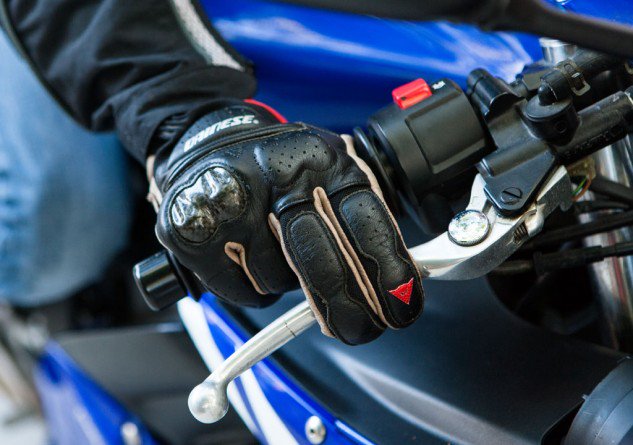
While maintaining a constant force per unit area on the brake, let your fingers slide over the lever while you lot blip the throttle for the downshift.
Earlier yous practice this technique on the route, sit on your bike in your driveway and rehearse maintaining a constant pressure on the brake lever while rolling the throttle on and off. Remember, although information technology's a challenge to modulate the brake and throttle simultaneously, you will be able to greatly shrink the distance it takes to slow and downshift one time you've mastered the skill.

Having the wrist in a level or slightly downwardly position makes information technology easier to operate the restriction and throttle simultaneously.
While the correct side of your body is treatment the brakes and the throttle, the left side of your body will be busy shifting gears and modulating the clutch. Here'due south one secret to make downshifting easier: You only demand to pull in the lever far enough to disengage the clutch plates. Pulling the lever all the way in is wasted effort that makes it more difficult to shift smoothly.
Motorbike Riding in the Air current and Rain
Some riders brand the motility easier by covering the clutch lever with ii fingers. Bumping the lever against your other fingers will remind you when yous've pulled it in too far. (To make sure you lot fully undo the clutch at a finish, go on to use all four fingers.)
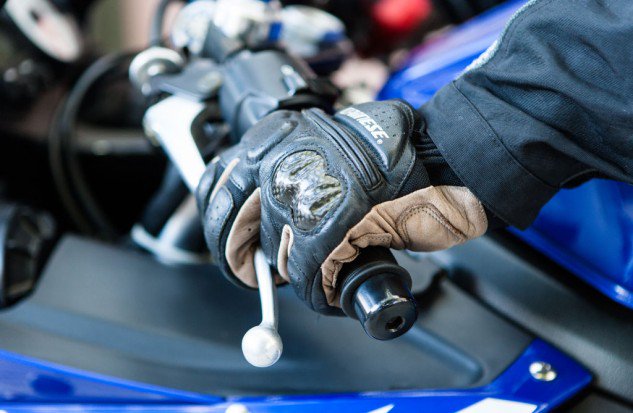
The clutch lever has been pulled in too far one time it hits your fingers. Efficiency of motility makes for smoother downshifts.
There's a trick for your foot, too: Although downshifting appears to exist simultaneous to the clutch action, yous'll want to preload the shifter by pressing downward on it just before you lot undo the clutch so the transmission will slip right into the next gear. Release the shifter as you normally would when the clutch is fully engaged.
The process is the aforementioned no thing how many gears you're going down through. Just let the clutch out fairly quickly between each shift. Don't tap down more than one gear while the clutch is in. Getting the downshift(due south) done early on in the braking will help mask any slight mistakes y'all make in matching the engine speed. This also lets you focus on setting your corner entry speed and getting off the brakes at the proper time.
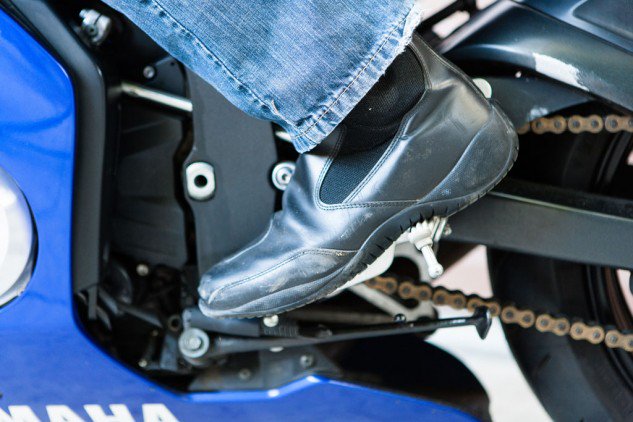
The rider's toe is pressing downwards on the shifter confronting the transmission's resistance. As soon as the clutch is disengaged, the lever will snick information technology into the lower gear.
Eliminating unnecessary movement from gear changes will help downshifts go much smoother. For clutch performance with a minimum of finger movement, make sure the bespeak of full clutch disengagement is as far out from the grip as possible while still allowing for 2 to 3mm of freeplay at the finish of the lever. Similarly, the gearshift lever should be gear up so that you don't need to lift your foot off the peg to printing downwardly on the shifter, but don't set it so low that it compromises upshifts.
How to Load your Motorcycle
Becoming proficient in simultaneous braking and downshifting will pay dividends in the city, highway and track. By being in the right gear for your speed, you volition be able to motor away from problem around town or stabilize the chassis for the dispatch from a canyon road'southward corner go out. All information technology takes is practice.

Smoothly braking while downshifting is perhaps the most hard motorcycle skill to main. Doing it in the wet earns bonus points
- Past Evans Brasfield
medinafarretionly.blogspot.com
Source: https://www.cycletherapynyc.com/learn-more-about--motorcycle-downshifting-techniques
0 Response to "When Downshifting on Harley Shifter Goes Down to Low and I Have to Lift Back Up to Shift Again"
Post a Comment